

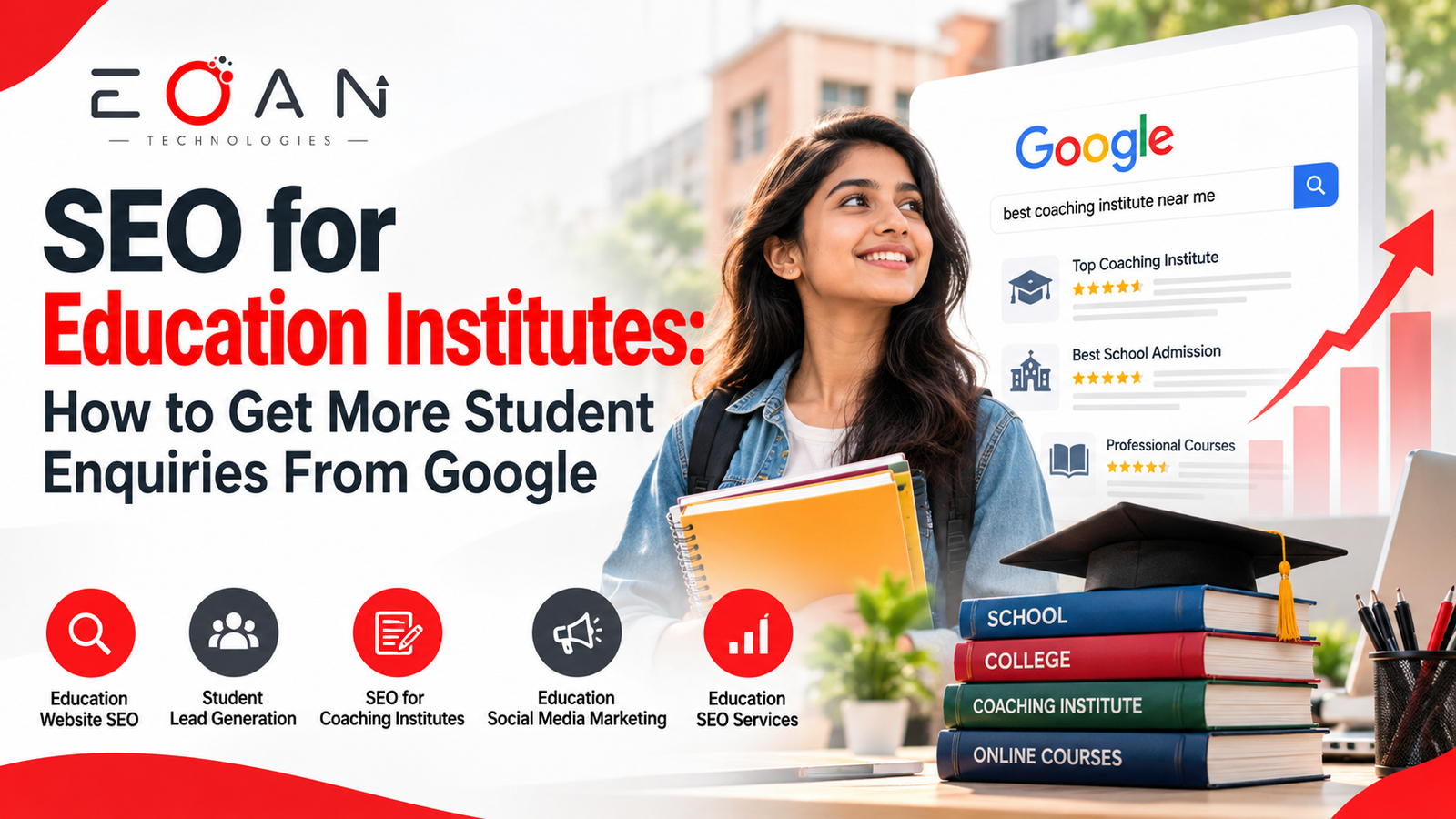
Education institutes face increasing competition when attracting students online. Schools, colleges, universities, coaching centres, online learning platforms, and professional training institutes must reach prospective students at the right time and provide clear reasons to choose their courses. Today, many students and parents begin their search on Google when looking for admission opportunities, entrance exam preparation, professional certifications, or skill development programmes.
This makes SEO for Education Institutes an important part of a long-term student acquisition strategy. A well-optimised website can help an institute appear in relevant search results, attract students who are actively looking for courses, and generate enquiries without relying entirely on paid advertising.
However, ranking on Google is only one part of the process. Education businesses also need informative landing pages, useful course information, strong local visibility, fast-loading websites, and convenient enquiry forms to convert visitors into potential students.
At Eoan Technologies, we help businesses strengthen their online presence through search engine optimisation, website development, and digital marketing strategies. In this guide, we explain how education institutes can use SEO to improve Google visibility and generate more relevant student enquiries.
Why SEO Matters for Education Institutes
Students and parents usually research multiple institutes before making an admission decision. They compare course fees, faculty experience, teaching methods, facilities, placement assistance, location, reviews, and previous results.
If your website does not appear when prospective students search for these details, your institute may miss valuable opportunities to connect with them.
Investing in SEO for Education Institutes helps improve visibility for searches related to your courses, location, admission process, and educational specialisations.
For example, an institute offering competitive exam preparation may target searches such as:
- Best coaching institute in Gurgaon
- NEET coaching classes near me
- JEE preparation classes in Delhi
- Online banking exam coaching
- Digital marketing courses with certification
- Best school for admissions in a particular city
These searches often indicate that users are actively evaluating educational options. Appearing for relevant queries allows your institute to attract interested visitors and encourage them to submit an enquiry.
SEO also offers long-term value. While paid advertising can generate traffic quickly, organic search visibility can continue attracting potential students as your website gains authority and your content meets users’ needs.
1. Identify the Right Keywords for Your Courses
Keyword research is the foundation of an effective education SEO strategy. Before creating content or optimising existing pages, identify what prospective students search for when looking for your courses.
Avoid focusing exclusively on broad terms such as “best college” or “coaching institute.” These keywords may have high competition and may not clearly communicate the searcher’s requirements.
Instead, build a keyword strategy around course names, student goals, locations, admission requirements, and specific learning needs.
Important keyword categories for education websites
Course-based keywords: Target searches related to individual courses, certifications, and academic programmes.
Examples include “data science course,” “spoken English classes,” and “MBA admission.”
Location-based keywords: Reach students searching for educational options in a particular area.
Examples include “coaching institute in Gurgaon,” “school in Noida,” and “computer training institute in Delhi.”
Admission-related keywords: Address students who want information about eligibility, application deadlines, fees, and entrance requirements.
Examples include “college admission process,” “MBA course fees,” and “documents required for school admission.”
Problem-solving keywords: Reach users researching subjects, examinations, and career decisions.
Examples include “how to prepare for NEET,” “best career options after graduation,” and “how to choose a coding course.”
Organise these keywords according to the intent behind each search. A person looking for course fees may need a detailed fee page, while someone searching for the best coaching institute may need a course overview, faculty information, reviews, and a comparison of available programmes.
A structured keyword strategy helps your website attract relevant visitors instead of simply increasing traffic.
2. Create Dedicated Landing Pages for Every Major Course
One common mistake education institutes make is placing all their programmes on a single page. Although this may keep the website simple, it limits the institute’s ability to rank for different course-related searches.
Each major course should have a dedicated landing page that explains what the programme offers and why it may be suitable for prospective students.
For example, a coaching institute offering NEET, JEE, CUET, and banking examination preparation should consider creating separate pages for each programme.
Every course page should include:
- Course overview and learning objectives
- Eligibility requirements and target audience
- Course duration and available learning formats
- Faculty qualifications and teaching methodology
- Batch schedules and important dates
- Fee information or a clear way to request fee details
- Genuine student testimonials and verified results, where available
- Frequently asked questions
- A prominent admission enquiry form or contact option
Use the primary keyword naturally in the page title, main heading, introduction, URL, and relevant subheadings where appropriate.
Avoid repeating the same keyword unnecessarily. Search engines need clear, useful information rather than content written solely to increase keyword frequency.
Well-structured landing pages make it easier for Google to understand your courses and help prospective students find the information they need before contacting your institute.
3. Improve Education Website SEO and Technical Performance
Your website is often the first interaction a prospective student has with your institute. A slow, confusing, or poorly organised website can discourage visitors from exploring your courses.
Education Website SEO includes technical improvements that help search engines crawl your pages and users access information efficiently.
Focus on these technical SEO elements
Mobile responsiveness: Many students research courses using smartphones. Your website should display properly across mobile phones, tablets, and desktop screens.
Page speed: Optimise images, reduce unnecessary scripts, use caching where appropriate, and select reliable hosting to improve loading performance.
Website structure: Organise pages into clear categories such as courses, admissions, faculty, student resources, locations, and contact information.
Indexing and crawling: Check Google Search Console for indexing problems, incorrect canonical tags, broken pages, and sitemap issues.
Secure browsing: Use HTTPS and maintain a secure website to protect users and support a trustworthy browsing experience.
Internal linking: Connect relevant blog articles to course pages and link related programmes where doing so helps users navigate the website.
Structured data: Implement appropriate structured data, such as Organisation, EducationalOrganization where applicable, BreadcrumbList, and Course markup when the content meets the relevant requirements. Validate the markup and do not assume that adding schema automatically guarantees enhanced search results.
Technical SEO creates a reliable foundation for your content and helps reduce the barriers that prevent prospective students from reaching your enquiry pages.
4. Use Local SEO to Attract Students From Nearby Areas
For schools, colleges, coaching centres, and offline training institutes, local visibility can directly influence admission enquiries.
A student searching for “IELTS coaching near me” or “school admission in Gurgaon” is often interested in options within a specific geographical area. Local SEO helps your institute become more visible for these location-based searches.
Start by creating and maintaining an accurate Google Business Profile, where your institute is eligible. Keep the business name, address, phone number, opening hours, website, and category information consistent with your actual operations.
Upload genuine photographs of classrooms, facilities, faculty, and campus activities. Respond professionally to reviews and answer common questions about courses and admissions.
Your website should also provide useful location-specific information. Include the institute’s address, directions, nearby landmarks, transport information, service area where relevant, and available courses.
If your organisation operates across multiple cities or campuses, create dedicated location pages when each location has genuinely distinct information to offer.
Do not create dozens of nearly identical city pages just to target different locations. Such pages often provide little value to visitors and may weaken the overall quality of your website.
A focused local strategy helps students understand where your institute operates and whether it meets their educational requirements.
5. Publish Helpful Educational Content to Build Organic Traffic
Students frequently search for information before deciding which institute to join. They may research entrance examinations, career options, subject difficulties, admission procedures, scholarships, and course comparisons.
Publishing useful articles gives your institute opportunities to reach these students earlier in their decision-making process.
A content strategy for SEO for Education Institutes should cover three broad stages of the student journey.
Awareness stage: Students are researching a subject or exploring possible careers.
Article ideas:
- Career Options After Class 12 for Science Students
- How to Prepare for Competitive Examinations
- Benefits of Learning Digital Marketing
- Skills Required for a Career in Data Analytics
Consideration stage: Students are comparing programmes and educational providers.
Article ideas:
- Online Courses vs Classroom Training
- How to Choose the Right Coaching Institute
- Important Factors to Consider Before Selecting a College
- Questions to Ask Before Joining a Professional Certification Course
Enquiry stage: Students are close to contacting an institute or applying for admission.
Article ideas:
- Course Fees, Duration, and Admission Requirements
- Documents Required for Admission
- Upcoming Batches and Application Deadlines
- How to Book a Counselling Session
Each article should answer the reader’s question clearly and direct interested visitors to the relevant course or admission page.
For example, a blog about NEET preparation can link to your NEET coaching page, while an article about digital marketing careers can guide readers towards your digital marketing programme.
Publish content that reflects your faculty’s expertise and actual course offerings. Review important educational information regularly, especially when examination patterns, admission requirements, or application deadlines change.
6. Improve Student Lead Generation With Better Conversion Paths
Generating website traffic is not enough. Your institute needs a clear process for turning interested visitors into enquiries.
Student Lead Generation improves when the website makes it easy for prospective students to take the next step.
Begin by placing visible calls to action on important pages. Suitable options include “Enquire About Admission,” “Request Course Details,” “Book a Counselling Session,” or “Speak to Our Admissions Team.”
The call to action should match the visitor’s intent. A student researching a course may prefer to request a brochure, while someone comparing coaching institutes may want to schedule a counselling session.
Make enquiry forms simple
Long forms can discourage users from submitting their details. Initially, request only the information needed for an appropriate follow-up.
A basic form might ask for:
- Student name
- Phone number or email address
- Course of interest
- Preferred campus or learning format, if relevant
You can collect additional information during the follow-up conversation rather than requiring every detail upfront.
Make sure the form works on mobile devices, displays clear validation messages, and sends submissions to the correct team. Include an appropriate privacy notice and obtain consent where required for communications and personal data processing.
Build trust before asking for an enquiry
Students and parents often need reassurance before sharing their contact information.
Support your enquiry process with genuine faculty profiles, transparent course details, student reviews, authentic campus photographs, and verifiable academic or placement information.
Avoid publishing fabricated testimonials, unverified placement statistics, or guaranteed admission and employment claims.
You should also track completed form submissions, phone calls, counselling bookings, and other meaningful conversion actions. This helps you identify which landing pages and keywords attract enquiries rather than just website visits.
7. Invest in Education SEO Services for a Structured Strategy
Education marketing involves several interconnected activities, including keyword research, technical SEO, content planning, landing page optimisation, local search visibility, and conversion tracking.
Managing all these activities internally can be challenging, particularly when your institute has multiple courses, campuses, or admission cycles.
Professional Education SEO Services can help establish priorities, identify technical issues, improve existing pages, and develop a consistent content strategy.
A comprehensive service plan may include:
- Website and technical SEO audits
- Keyword research and competitor analysis
- Course page optimisation
- Local SEO and Google Business Profile optimisation
- Educational blog planning and content optimisation
- Internal linking and site architecture improvements
- Relevant authority-building activities
- Google Search Console and analytics reporting
- Conversion tracking and lead quality analysis
When evaluating an Education SEO Agency, look beyond promises of quick rankings or guaranteed student enquiries.
Ask how the agency measures success, what work it will deliver, how it handles content quality, and how it reports progress. The strategy should reflect your institute’s courses, locations, competition, admission calendar, and available budget.
SEO is a long-term process. Meaningful results depend on your starting position, market competition, website quality, content relevance, and the consistency of implementation.
8. Combine SEO With Education Social Media Marketing
Google search and social media serve different purposes, but they can complement one another.
SEO helps students find your institute when they actively search for courses and educational information. Education Social Media Marketing helps build awareness, showcase the learning environment, communicate updates, and maintain engagement with prospective students and parents.
Your institute can share faculty introductions, campus tours, course explainers, student activities, admission announcements, and useful study tips across suitable platforms.
Short videos explaining examination preparation or demonstrating practical training sessions can help prospective students understand what your institute offers.
Social media can also support your SEO content strategy. Share useful blog articles, admission guides, and course pages through relevant social channels to bring interested users to your website.
However, social media engagement does not automatically improve organic rankings. Treat these channels as complementary ways to build awareness, distribute content, and attract potential students.
Maintain consistent branding, provide accurate course information, and ensure that every campaign leads users towards a relevant next step.
9. Track the SEO Metrics That Matter for Admissions
An effective SEO strategy should be evaluated through measurable results rather than rankings alone.
A keyword may rank well but generate few relevant enquiries. Another page may receive less traffic but attract students who are ready to apply.
Use Google Search Console and suitable analytics or CRM tools to monitor performance.
| SEO metric | What it tells you |
| Organic clicks | How many visits come from Google organic search |
| Search impressions | How often your pages appear in search results |
| Click-through rate | How frequently users click after seeing a result |
| Course page engagement | Whether visitors interact with important course information |
| Enquiry conversion rate | The percentage of relevant visitors who submit enquiries |
| Qualified student enquiries | How many leads match your admission criteria |
| Admission conversion rate | How many enquiries eventually become enrolled students |
Review these metrics by course, location, landing page, and acquisition source wherever reliable tracking is available.
For example, if a coaching page receives substantial organic traffic but very few enquiries, review the page’s content, form usability, calls to action, fee information, and mobile experience.
If enquiry volume increases but lead quality declines, revisit your keyword targeting and the clarity of your course information.
This approach helps your institute make informed decisions about which pages to improve and where to invest further resources.
10. Build a Practical 90-Day SEO Plan for Your Institute
A structured implementation plan makes SEO easier to manage and evaluate.
Days 1–30: Audit and research
- Review the existing website and technical SEO.
- Research course-specific and location-based keywords.
- Identify the most important admission and course pages.
- Set up or verify Google Search Console and conversion tracking.
- Review the current enquiry process and establish baseline metrics.
Days 31–60: Optimisation and content development
- Improve titles, headings, content, and internal links on priority pages.
- Resolve important technical and mobile usability issues.
- Strengthen local SEO where relevant.
- Publish helpful educational articles linked to relevant courses.
- Improve enquiry forms and calls to action.
Days 61–90: Evaluation and refinement
- Review changes in impressions, clicks, and keyword visibility.
- Identify pages that attract traffic but produce few enquiries.
- Improve underperforming content and landing pages.
- Assess enquiry quality and admission-related outcomes.
- Plan the next quarter’s content and optimisation priorities.
This timeline is a working framework, not a guarantee of rankings or admission results within 90 days. Some improvements may produce early gains, while competitive keywords and new websites may require considerably more time.
How Eoan Technologies Helps Education Institutes Grow Online
At Eoan Technologies, we understand that education marketing needs to do more than attract website visitors. Institutes need to reach the right students, communicate their value clearly, and make it convenient for interested people to enquire about admissions.
Our digital marketing approach can combine SEO, website optimisation, content marketing, local search optimisation, and social media marketing according to the institute’s objectives.
Whether you operate a school, college, coaching centre, professional training institute, or online education business, the first step is to understand your courses, target audience, competitors, and existing website performance.
Based on this assessment, we can prioritise the pages, keywords, technical improvements, and content opportunities most relevant to your business.
We focus on building a sustainable online presence with useful content, transparent reporting, and measurable performance indicators. Instead of treating rankings as the only objective, we consider how organic visibility contributes to relevant student enquiries and business growth.
Conclusion
Generating more student enquiries from Google requires a coordinated approach to keyword research, course page optimisation, technical SEO, local visibility, educational content, and conversion tracking.
SEO for Education Institutes works best when your website answers students’ questions, demonstrates the value of your programmes, and provides a straightforward path to enquire about admissions.
By improving your Education Website SEO, investing in relevant Education SEO Services, strengthening local search visibility, and using Education Social Media Marketing to complement your organic strategy, your institute can build a stronger digital presence over time.
At Eoan Technologies, we help businesses develop practical digital marketing strategies that connect them with relevant audiences. If your institute wants to improve Google visibility and attract more qualified student enquiries, contact Eoan Technologies to discuss an SEO strategy aligned with your courses, target locations, and admission goals.