

The eCommerce industry is growing rapidly, and online stores need more than attractive product pages to succeed in a competitive digital marketplace. Customers use search engines to discover products, compare prices, read reviews, and find reliable online retailers. If your online store doe
s not appear in relevant search results, you may miss valuable opportunities to attract potential customers and increase sales.
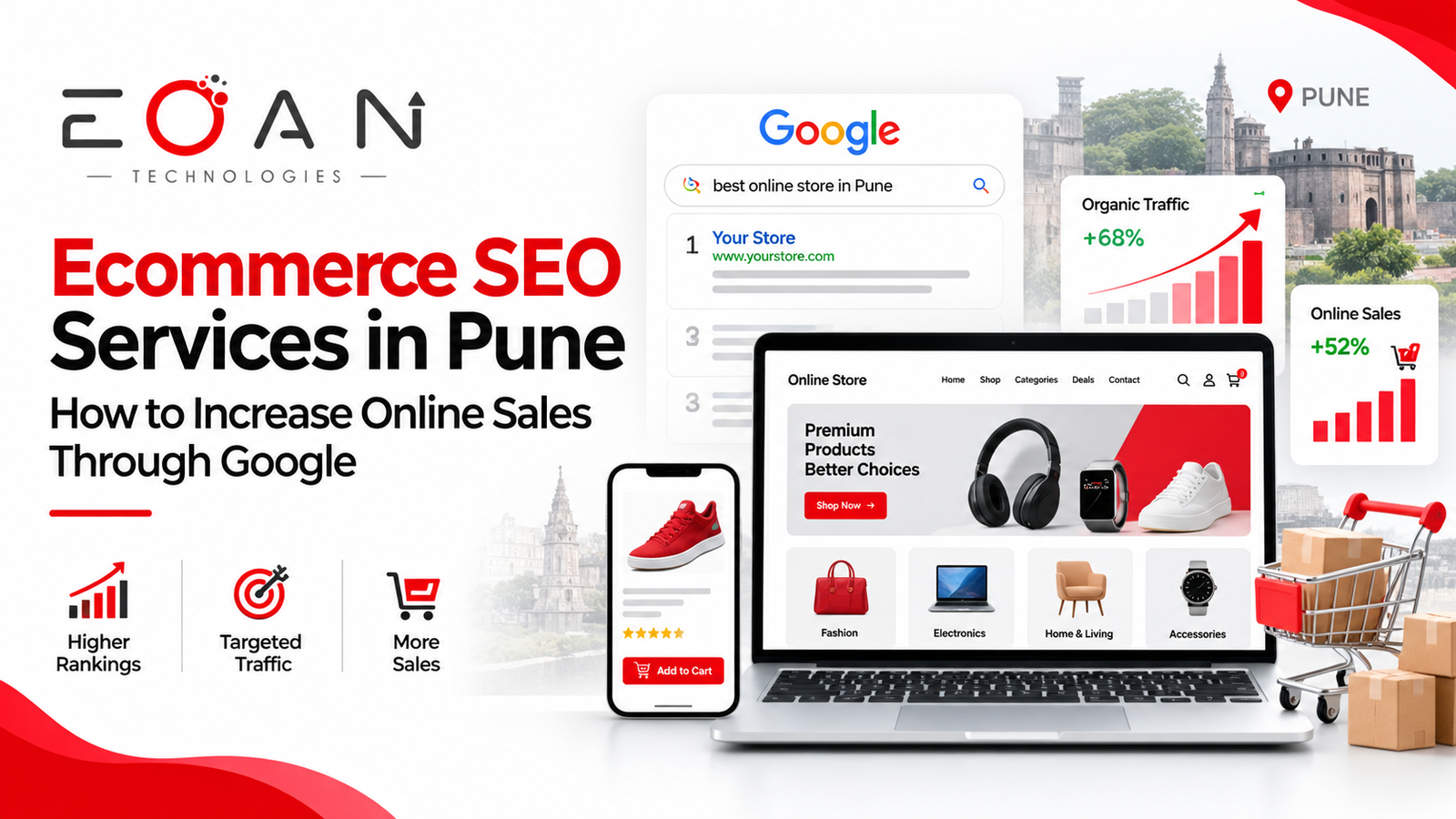
This is where Ecommerce SEO Pune becomes important for businesses looking to improve their online presence. A well-planned eCommerce SEO strategy helps online stores improve product visibility, attract relevant organic traffic, enhance the shopping experience, and generate more conversions without depending entirely on paid advertising.
Whether you operate a Shopify store, a WooCommerce website, or a custom eCommerce platform, search engine optimization can help your business reach customers who are actively searching for your products. By combining technical SEO, product page optimisation, keyword research, and content marketing, online retailers can build a stronger foundation for sustainable growth.
What Is Ecommerce SEO and Why Does It Matter?
Ecommerce SEO is the process of optimising an online store so that its product pages, category pages, and other important website sections can perform better in organic search results.
Unlike general website SEO, eCommerce SEO focuses specifically on helping customers discover products and move towards purchasing them. It involves improving website structure, product descriptions, category content, internal linking, page speed, and other factors that influence search visibility and user experience.
For businesses targeting customers in Pune and across India, an effective SEO strategy can help attract shoppers searching for specific products and solutions.
For example, an online electronics retailer may want to appear for searches related to wireless headphones, while a fashion store may target searches for women’s ethnic wear or men’s casual clothing. Optimising the relevant product and category pages helps search engines understand what the store offers.
The key benefits of eCommerce SEO include increased organic visibility, more qualified website traffic, improved product discovery, stronger brand credibility, and greater opportunities to generate sales.
How Ecommerce SEO Pune Helps Online Stores Increase Product Visibility
Product visibility is essential for attracting customers who are already interested in buying. When shoppers search for a product, they often explore several results before choosing a retailer. Appearing prominently for relevant searches can help your store become part of that decision-making process.
A targeted Ecommerce SEO Pune strategy starts by understanding your products, target audience, competitors, and customer search behaviour.
1. Conduct Strategic eCommerce Keyword Research
Keyword research helps identify the search terms customers use when looking for products online. The objective is to find relevant keywords that reflect customer needs and purchasing intent.
For example, someone searching for “running shoes” may be exploring different options, while someone searching for “buy lightweight running shoes online” may be closer to making a purchase.
Both types of searches can be valuable, but they may require different pages and content.
An effective keyword strategy should include product-specific keywords, category keywords, long-tail search phrases, and transactional queries. Businesses should also consider product attributes such as size, colour, material, model, and intended use where relevant.
Once the keywords are identified, they should be mapped to appropriate pages rather than repeated across every product listing.
This approach helps reduce keyword cannibalisation and creates a more organised website structure.
2. Optimise Product Titles and Descriptions
Product titles and descriptions help customers understand what they are buying and help search engines interpret page content.
A strong product title should identify the product clearly and include meaningful attributes when appropriate. For example, instead of using a vague title such as “Premium Shoes,” a retailer could use “Men’s Lightweight Running Shoes for Daily Training.”
Product descriptions should explain the main features, practical benefits, specifications, materials, sizing information, and intended use of the product.
Avoid copying descriptions directly from manufacturers or competitors. Duplicate or generic descriptions make it harder for a store to demonstrate unique value to shoppers.
Original descriptions can also answer common questions, address purchase concerns, and help customers decide whether a product suits their needs.
Businesses should naturally incorporate relevant keywords into product content while keeping the writing clear, accurate, and persuasive.
3. Improve Category Pages for Better Rankings
Category pages are often important entry points for online shoppers. Customers may search for a broad product category before selecting a particular item.
For instance, a store selling home furnishings might have separate categories for office chairs, dining tables, bedroom furniture, and storage solutions.
Each category page should have a clear heading, descriptive introductory content where useful, relevant product listings, and an intuitive navigation structure.
Category descriptions should explain the types of products available and help customers understand their options. They should not contain unnecessary paragraphs added only to increase word count.
Internal links between relevant categories, subcategories, and product pages can also help users discover products and allow search engines to understand relationships between different pages.
Well-organised category pages make shopping easier while creating additional opportunities to rank for relevant commercial keywords.
Technical SEO for eCommerce Websites
Technical SEO is an essential part of any online store optimisation strategy. Even high-quality product content may struggle to perform if search engines cannot efficiently crawl, understand, or index important pages.
Professional Ecommerce SEO Services Pune can help businesses identify and resolve technical issues that affect website performance and search visibility.
4. Improve Website Speed and Mobile Experience
Online shoppers expect websites to load quickly and work smoothly across different devices. Slow-loading pages, difficult navigation, and complicated checkout processes can discourage customers from completing purchases.
Retailers should optimise product images, reduce unnecessary scripts, use suitable caching methods, and review their hosting performance where appropriate.
Mobile usability is equally important because many customers browse products and make purchases using smartphones.
Product images should display correctly, product details should remain readable, and buttons such as “Add to Cart” should be easy to use.
Google’s Core Web Vitals measure loading performance, responsiveness, and visual stability. Improving these metrics can support a better user experience, although good scores do not guarantee higher rankings.
A fast, accessible, and mobile-friendly store makes it easier for visitors to explore products and complete transactions.
5. Fix Duplicate Content and Indexing Problems
eCommerce websites can generate duplicate or near-duplicate URLs through product filters, sorting options, tracking parameters, and product variations.
For example, a category page may be accessible through several URLs depending on the selected colour, price range, or sorting preference.
If these URLs are not managed carefully, search engines may spend resources crawling unnecessary pages or struggle to identify the most appropriate version of the content.
Businesses should review canonical tags, robots directives, XML sitemaps, internal links, and indexing settings to help search engines prioritise important URLs.
Product variations should also be handled consistently. Depending on the products and website architecture, separate pages or a shared product page may be appropriate.
The correct approach depends on whether the variations offer meaningful independent search value and how customers navigate the store.
Resolving these technical issues helps maintain a cleaner website structure and supports more effective crawling and indexing.
Shopify SEO Services Pune: How to Optimise Shopify Stores
Shopify provides a convenient platform for launching and managing an online store, but store owners still need an effective SEO strategy to compete in organic search results.
Shopify SEO Services Pune can help businesses optimise their Shopify stores by improving product information, collection pages, internal linking, technical settings, and overall user experience.
6. Optimise Shopify Product and Collection Pages
Shopify product pages should include descriptive titles, unique product descriptions, relevant images, and useful specifications. Product and collection pages should also have appropriate title tags and meta descriptions.
Collection pages need clear naming and logical organisation so customers can browse related products without confusion.
Store owners should review automatically generated URLs and avoid unnecessary changes to established URLs. When URL changes are necessary, suitable redirects should be implemented to help users and search engines reach the correct destination.
Shopify themes, applications, and tracking scripts should also be reviewed periodically to identify unnecessary code that could affect performance.
Another important consideration is app management. Installing too many overlapping SEO applications may create complexity without delivering meaningful improvements.
A focused Shopify SEO strategy prioritises the features and optimisations that support the store’s specific requirements.
Ecommerce Website Ranking Services: Content That Attracts Buyers
High-quality content can help online stores reach customers at different stages of the buying journey. Some shoppers know exactly what they want, while others need guidance before choosing a product.
Ecommerce Website Ranking Services should therefore focus on more than product descriptions alone. A broader content strategy can help retailers answer customer questions, demonstrate product knowledge, and build trust.
7. Create Helpful Buying Guides and Product Comparisons
Buying guides provide useful information for customers who are comparing products or exploring available options.
For example, an electronics retailer could publish a guide to choosing wireless headphones, while a skincare store could explain how different moisturisers suit different skin types.
Product comparison articles can also help customers understand the differences between models, features, and price ranges.
These resources should be informative, accurate, and connected to relevant category or product pages through natural internal links.
A useful buying guide should answer genuine customer questions rather than simply repeat keywords. It should also be updated when products, specifications, or recommendations change.
By helping shoppers make informed decisions, content marketing can support product discovery and encourage visitors to explore relevant items.
8. Use Product Reviews and Structured Data Correctly
Customer reviews can provide valuable information about product quality, usability, fit, and overall satisfaction. Genuine reviews may help shoppers feel more confident about purchasing from an online store.
Retailers should make it easy for customers to leave honest feedback and respond professionally to concerns.
Structured data can also help search engines interpret information such as product names, prices, availability, ratings, and other supported attributes.
For eligible pages, correctly implemented product structured data may make the content eligible for certain enhanced search appearances. However, eligibility does not guarantee that enhanced results will be displayed.
Businesses must ensure that structured data accurately reflects visible page information and complies with search engine guidelines.
Fake reviews, misleading availability information, and inaccurate pricing markup should be avoided.
How Local SEO Supports eCommerce Businesses in Pune
Although many online stores sell products across India, some retailers also serve customers in Pune through local delivery, physical showrooms, pickup services, or regional promotions.
In these situations, local SEO can complement a broader eCommerce strategy.
Businesses can create useful location-specific pages when they offer genuine local services or have meaningful information to share with customers in Pune.
For example, an electronics retailer with a physical showroom could provide accurate store details, directions, opening hours, and pickup information.
Eligible businesses with in-person customer contact may also benefit from maintaining an accurate Google Business Profile. However, an online-only business without qualifying in-person contact should not create a profile that violates Google’s eligibility requirements.
Local landing pages should provide unique information and genuine customer value rather than duplicating the same content for different neighbourhoods.
The goal is to connect online product discovery with the services the business can actually provide in the local market.
Why Work With an Ecommerce SEO Expert Pune?
Managing an eCommerce website involves many moving parts, including product updates, inventory changes, technical maintenance, content creation, and marketing campaigns.
Working with an ecommerce SEO expert Pune can help businesses develop a structured optimisation plan and prioritise activities that support commercial objectives.
An experienced SEO professional can review the website architecture, identify technical issues, analyse keyword opportunities, and evaluate how competitors attract organic traffic.
They can also help improve product and category content, strengthen internal linking, and establish a reporting process to monitor results.
Before selecting an SEO provider, businesses should look for transparent communication, a clear scope of work, ethical practices, and a strategy tailored to their products and customers.
Avoid providers that promise guaranteed first-page rankings or immediate sales growth. SEO outcomes depend on multiple factors, including competition, website quality, pricing, demand, and customer experience.
The right partner should explain what will be done, why it matters, how performance will be measured, and where further improvements may be needed.
How to Measure eCommerce SEO Performance
Tracking performance helps store owners understand whether SEO activities are improving visibility and contributing to business growth.
Important metrics include:
- Organic traffic: Visitors arriving through unpaid search results.
- Search impressions and clicks: How often product and category pages appear in search and attract visits.
- Keyword visibility: Performance for relevant product and category searches.
- Product page engagement: How visitors interact with important product pages.
- Conversion rate: The percentage of visitors who complete a purchase or another desired action.
- Organic revenue: Revenue attributed to organic search through an appropriate analytics setup.
- Average order value: The average revenue generated per completed order.
- Cart abandonment: The proportion of shopping carts that do not result in a completed purchase.
Google Search Console can help monitor search performance, while Google Analytics and eCommerce reporting tools can provide insight into purchases and user behaviour.
Businesses should interpret these metrics together. An increase in organic traffic is useful, but the commercial value depends on whether that traffic reaches relevant products and contributes to profitable sales.
Regular reporting also helps identify underperforming product pages, seasonal trends, and opportunities to improve conversion rates.
Common eCommerce SEO Mistakes to Avoid
Online retailers can limit their search performance by overlooking several important areas.
One common mistake is using the same product descriptions across many pages. Unique, informative descriptions help customers understand product differences and make pages more useful.
Another problem is neglecting discontinued or out-of-stock products. These pages should be handled according to their long-term value, availability, replacement products, and existing search demand rather than removed automatically.
Poor website navigation can also make it difficult for customers to discover products. Clear categories, helpful filters, breadcrumbs, and relevant internal links can improve usability.
Keyword stuffing is another practice to avoid. Repeating “Ecommerce SEO Pune” unnaturally throughout a page does not create useful content and can harm readability.
Retailers should also avoid relying entirely on paid advertising. Paid campaigns can generate immediate visibility, while SEO can build an additional source of organic traffic over time. Combining both approaches may support a more balanced digital marketing strategy.
Finally, failing to monitor technical issues, product availability, and conversion data can prevent businesses from identifying opportunities for improvement.
Conclusion: Grow Your Online Store With Ecommerce SEO Pune
Improving product visibility and increasing online sales requires a coordinated approach to keyword research, product page optimisation, technical SEO, website performance, content marketing, and conversion tracking.
A well-executed Ecommerce SEO Pune strategy helps online stores connect with relevant shoppers, improve the discovery of important products, and create a more convenient buying experience. Whether you manage a Shopify store, a WooCommerce website, or a custom eCommerce platform, consistent optimisation can support long-term organic growth.
Eoan Technologies offers digital marketing solutions designed to help businesses strengthen their search visibility, improve website performance, and reach relevant audiences. By combining SEO fundamentals with data-driven optimisation, businesses can build a stronger foundation for sustainable online growth.
If you want to improve your store’s organic visibility, attract more qualified visitors, and create better opportunities for sales, explore Eoan Technologies and develop an SEO strategy aligned with your eCommerce business goals.