

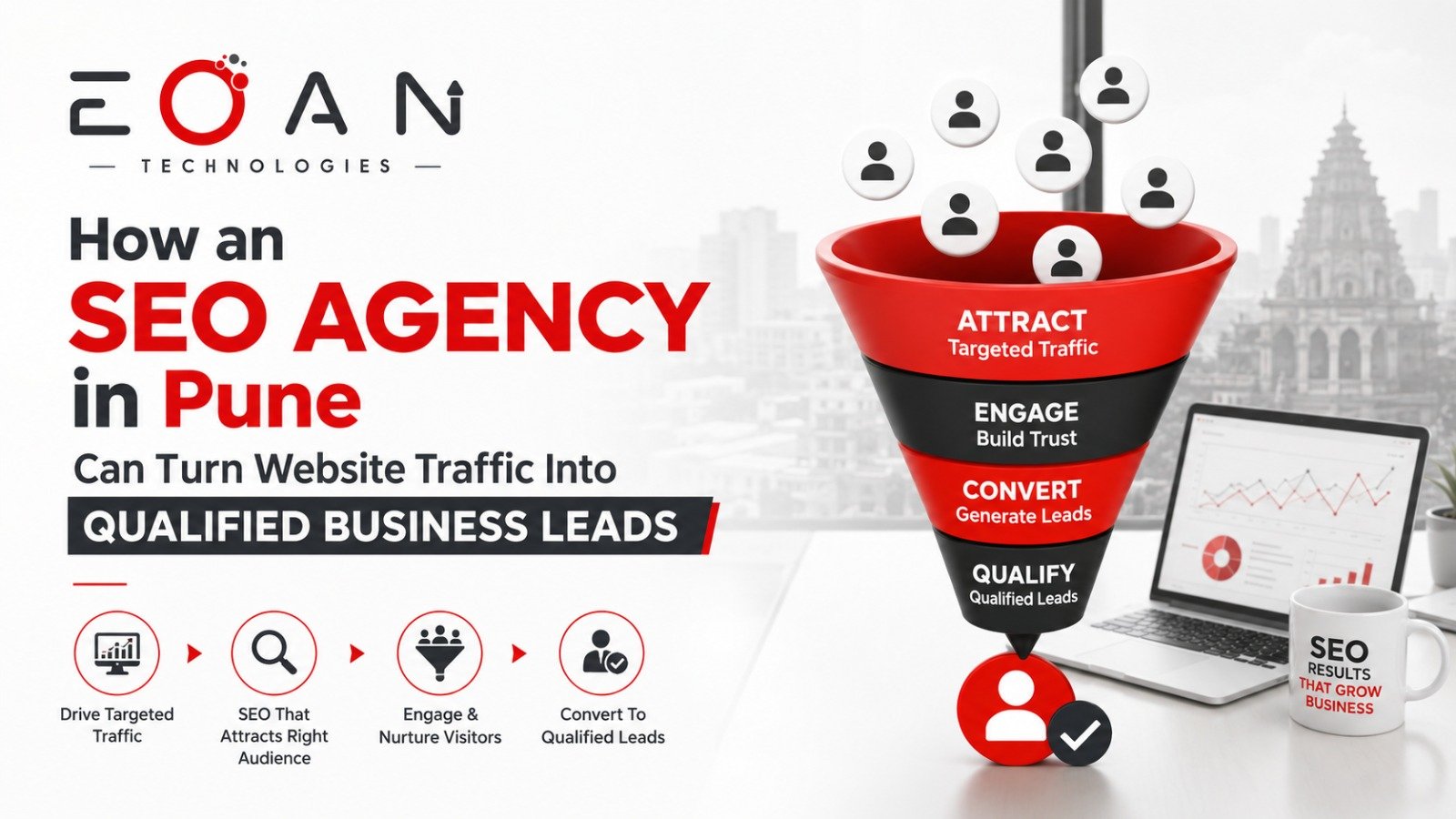
in Pune, the bigger opportunity is to connect search visibility with commercial intent. seo agency in pune strategies should therefore focus not simply on increasing rankings, but on attracting people who are genuinely looking for a product, service or solution and then helping those visitors take the next appropriate step.
Eoan Technologies positions its SEO offering around measurable growth, quality leads, search visibility and conversion rather than rankings alone. Its Pune-focused SEO service page also highlights technical SEO, local search, behavioural insights, content optimisation, backlink strategies and AI search visibility as parts of its broader approach.
This article explains how that approach can turn organic website traffic into more commercially valuable opportunities, what needs to happen between a Google search and a business enquiry, and which areas businesses should examine before judging SEO performance.
Why Website Traffic Does Not Automatically Become Leads
Traffic is only the beginning of the customer journey. A visitor becomes valuable to a business when their visit has a realistic connection to a commercial objective, such as submitting an enquiry, requesting a consultation, calling the business, purchasing a product or taking another meaningful action.
This distinction matters because not every search has the same intent.
Someone searching for “what is technical SEO?” may simply want information. Someone searching for “SEO services for a manufacturing company” is much closer to evaluating providers. Both searches can generate organic traffic, but their likelihood of producing a sales opportunity is very different.
Traffic quality matters more than traffic volume
A useful SEO strategy begins by asking a simple question: Who should be visiting the website?
The answer depends on the business model, target market, service offering and buying journey. A B2B company may want decision-makers researching suppliers, while a local service business may be more interested in people actively looking for a provider in their area.
High-quality organic traffic usually has several characteristics:
- It comes from searches relevant to the business.
- The visitor’s intent matches the page they land on.
- The content answers the question or problem behind the search.
- The visitor can easily understand what the business offers.
- There is a logical next step when the visitor is ready to enquire.
This is why seo company in pune campaigns should not be evaluated purely through sessions or keyword rankings. Those metrics can provide useful context, but they do not tell the complete story.
A page ranking for an irrelevant or very broad query may receive impressions without producing meaningful business value. Conversely, a page attracting a smaller number of highly relevant visitors can generate stronger commercial opportunities.
Search intent connects visibility with commercial value
Search intent is the reason behind a user’s query. Understanding it allows an SEO strategy to distinguish between people looking for education, comparison, solutions or a provider.
Four broad intent categories are particularly useful:
- Informational intent: The user wants to learn something.
- Navigational intent: The user is trying to find a particular website or brand.
- Commercial investigation: The user is comparing options before making a decision.
- Transactional intent: The user is ready to take action or purchase.
A strong content strategy can support users across these stages instead of attempting to push every visitor directly towards a sales enquiry.
For example, an informational article can establish expertise and answer an early-stage question. A detailed service page can then explain the available solution. Case studies, FAQs, reviews and clear service information can help a prospective customer evaluate whether the provider is suitable.
That creates a more natural relationship between search visibility and lead generation.
Why rankings should be viewed alongside business metrics
Ranking positions are useful indicators, but they should not become the sole definition of success.
Businesses should also monitor metrics such as:
- Organic enquiries
- Qualified leads
- Contact-form submissions
- Phone calls generated from organic search
- Conversion rate by landing page
- Engagement with important service pages
- Organic leads by search intent
- Cost and value of acquiring organic prospects
This broader view helps identify whether SEO is attracting the right audience and whether the website is successfully converting that audience.
Eoan Technologies describes its SEO approach as being centred on growth metrics rather than keyword positions alone. Its website also states that campaign reporting can include traffic, conversions, backlinks and keyword performance.
How SEO Connects Search Intent With Qualified Leads
Turning visitors into qualified prospects requires more than optimising individual pages. The entire path from search query to conversion needs to make sense.
A visitor should ideally find a page that matches what they were searching for, receive enough information to understand the solution, gain confidence in the business and encounter a clear next step.
This is where seo services in pune can contribute to the commercial side of a website when they are structured around customer intent rather than isolated keyword targets.
Start with the problems customers are trying to solve
Keyword research should go beyond identifying phrases with search volume. The more useful question is what the search reveals about the user’s problem.
Consider a business selling professional services. Potential customers might search for:
- How to solve a specific business problem
- What a particular service includes
- How much a service typically involves
- Which provider is suitable
- Whether a particular solution is appropriate
- How one provider differs from another
Each type of search can require a different page or content format.
A service page should generally explain the service and its relevance. An educational article should answer the underlying question thoroughly. A comparison page can help users evaluate alternatives. A location-focused page may address local requirements and service availability.
This creates a structured content ecosystem rather than a collection of disconnected articles.
Build landing pages around the visitor’s next question
Imagine that a prospective customer discovers a service page through Google. The page should answer the questions that naturally follow the original search.
Depending on the service, those questions may include:
- What exactly does the service involve?
- Who is it suitable for?
- What problems can it address?
- What process does the provider follow?
- What should the customer prepare?
- How can progress be measured?
- What happens after the initial enquiry?
Answering these questions reduces uncertainty.
The objective is not to pressure every visitor into contacting the business immediately. Instead, the page should provide enough relevant information for a suitable prospect to recognise that the business may be able to help.
Use content to qualify visitors, not just attract them
Content can work as a filtering mechanism.
Suppose a company provides a specialised service. A detailed article explaining who benefits most from that service may attract fewer people than a broad introductory article, but the audience could be more commercially relevant.
This is particularly valuable for businesses that receive enquiries from people who are not a good fit.
Useful content can establish:
- The type of customer the business serves
- The problems it addresses
- The situations in which its services are appropriate
- The expected decision-making process
- The information prospects should consider before making contact
That means content does not simply generate visits. It helps potential customers understand whether they have a genuine reason to enquire.
Connect informational content to commercial pages naturally
Internal linking plays an important role in moving users through the website.
An educational article can naturally link to a relevant service page when the reader needs more detailed information. A service page can link to related resources, FAQs or supporting information where those resources help the visitor make a better decision.
For Eoan Technologies, the website already contains distinct sections covering SEO, local SEO, web design, social media marketing, reputation management and other digital services, alongside industry-specific areas such as healthcare, travel, education and legal services.
This type of structure creates opportunities to connect informational content with relevant commercial resources without forcing promotional links into every paragraph.
The Website Experience Determines What Happens After the Click
Search visibility can bring a potential customer to a website, but the website itself must then do its share of the work.
If a visitor lands on a slow, confusing or poorly structured page, even highly relevant organic traffic can leave without taking action. SEO and conversion optimisation should therefore work together.
Match the landing page with the search query
One of the simplest ways to improve lead quality is to make sure the landing page delivers what the searcher expected.
If someone searches for a specific service and reaches a generic homepage, they may have to work too hard to find the information they need.
A more focused landing page can immediately establish:
- What the service is
- Who it is designed for
- What problem it addresses
- Why the visitor should continue reading
- What action is available next
The closer the relationship between the search query, search result and landing page, the easier it becomes for the visitor to continue their journey.
Make important information easy to find
Visitors should not have to search extensively for basic information.
Important service pages should make relevant information accessible through clear page structure, descriptive headings and straightforward navigation. Supporting elements such as FAQs, trust signals, process explanations and useful resources can also reduce uncertainty.
This is particularly important for visitors arriving through organic search because they may have no previous relationship with the brand.
Improve the path towards meaningful action
A conversion does not always mean completing a purchase.
For some businesses, an appropriate conversion may be:
- Requesting a consultation
- Submitting an enquiry
- Calling the company
- Requesting a proposal
- Booking a discussion
- Downloading a useful resource
The correct action depends on the business and the visitor’s position in the buying journey.
The key is to make the next step obvious without making the page feel aggressive or overly promotional.
Eoan Technologies’ website reflects this broader conversion-oriented approach by describing its SEO methodology in terms of visibility, engagement and conversion, while its behavioural SEO discussion focuses on user interaction, page layouts, calls to action, internal links and content flow.
Technical performance supports conversion
Technical SEO is not only about helping search engines crawl and index a website. Technical problems can also interfere with the user experience.
Areas worth reviewing include:
- Mobile usability
- Page loading performance
- Crawlability
- Indexation
- Broken links
- Internal linking
- Structured data
- Core Web Vitals
- Navigation
- Page templates
A technically sound website gives users a more reliable path from discovery to action.
For businesses competing for high-intent searches, that matters because the commercial value of an organic visit depends on what happens after the visitor arrives.
The strongest SEO strategy therefore treats rankings, content, technical performance, user behaviour and conversion paths as connected parts of one system rather than separate activities.
How Content, Local Search and Authority Can Improve Lead Quality
Once the technical foundation and user journey are working properly, the next challenge is attracting the right people consistently. This requires a content and authority strategy built around the questions, needs and decision-making behaviour of the target audience.
Organic visibility becomes more valuable when the website demonstrates clear relevance across a subject rather than relying on isolated pages. Search engines need to understand what a business offers, who it serves and which topics it can provide useful information about. Users need the same clarity.
Create content for different stages of the buying journey
Not every potential customer is ready to make an enquiry during their first visit. Some are still researching the problem, while others may already be comparing providers.
A useful content strategy can address several stages:
- Awareness: Explain problems, concepts and potential solutions.
- Consideration: Help readers compare approaches and understand important factors.
- Evaluation: Explain services, processes, expertise and suitability.
- Action: Make it straightforward for an interested prospect to enquire.
This approach prevents a website from depending entirely on service pages for lead generation.
For example, an educational article can answer a common question and introduce the subject to a new audience. A more detailed guide can then help that reader understand possible approaches. A relevant service page can provide information for people who are ready to evaluate professional assistance.
The objective is to create useful connections between these pages.
Demonstrate expertise instead of making broad claims
Businesses often describe themselves using phrases such as “experienced”, “professional” or “leading”. Those descriptions are less persuasive when they are not supported by useful evidence.
A stronger approach is to demonstrate expertise through the quality of the information provided.
A business website can do this by explaining:
- How its processes work
- What factors it considers before recommending an approach
- Which problems commonly affect customers
- What businesses should evaluate before choosing a provider
- How progress can be measured
- What limitations or challenges customers should understand
This style of content is more useful to both readers and search systems because it provides context rather than simply making promotional statements.
For businesses considering seo experts in pune, the same principle applies when evaluating providers. A credible agency should be able to explain its methodology, priorities, reporting approach and reasoning in a way that a prospective client can understand.
Use local relevance without over-optimising pages
Local SEO can be particularly useful when customers want to work with a provider serving a specific geographic market.
However, effective local optimisation is more than adding a city name repeatedly to headings and paragraphs.
A locally relevant page should provide genuine context. Depending on the business, this may include information about the market served, the types of customers supported, the service area and the problems customers in that market commonly face.
For Eoan Technologies, Pune is one of the locations addressed through its dedicated SEO offering. The company’s website describes local SEO as part of its approach and discusses improving visibility for geographically relevant searches.
This makes geographic relevance part of the overall search strategy rather than simply a keyword insertion exercise.
Build authority through relevant external signals
Links from other websites can help search engines discover relationships between websites and topics, but link acquisition should be approached carefully.
A sustainable authority strategy focuses on relevance and credibility rather than collecting large numbers of unrelated links.
Useful approaches can include:
- Publishing genuinely useful original resources
- Creating research or data-led content when reliable data is available
- Earning mentions from relevant publications
- Building relationships within appropriate industry communities
- Producing resources that other websites have a genuine reason to reference
The quality and relevance of a website’s overall authority profile matter more than simply pursuing an arbitrary link count.
How to Measure Whether Organic Visitors Are Becoming Qualified Leads
An SEO campaign should be measured according to the business objective. If the objective is lead generation, reporting should make it possible to understand what happens after people arrive through organic search.
A traffic graph can show whether visits are increasing, but it cannot by itself show whether those visits are commercially useful.
Separate visibility metrics from conversion metrics
Different metrics answer different questions.
Visibility metrics can help determine whether the website is becoming more discoverable. These may include search impressions, rankings and organic clicks.
Engagement metrics provide information about what visitors do after arriving. Depending on the analytics setup, these may include engagement, important page visits and interactions with site elements.
Conversion metrics indicate whether users are completing actions that matter to the business.
A useful reporting framework should connect these layers.
For example:
Search visibility → Relevant visit → Landing-page engagement → Enquiry → Qualified opportunity
This sequence is much more informative than looking at keyword positions independently.
Track lead quality, not just lead quantity
Ten enquiries are not necessarily better than five.
If most enquiries are unrelated to the service, outside the target market or unlikely to become customers, increasing the raw enquiry count may not improve business performance.
Businesses should therefore work towards defining what a qualified lead means.
Depending on the organisation, qualification criteria might include:
- The prospect needs a service the business actually provides.
- The prospect fits the intended market.
- The enquiry contains a genuine business requirement.
- The prospect has a realistic timeline.
- The prospect has reached an appropriate stage in the buying process.
Once these criteria are understood, SEO reporting can become much more useful.
Connect analytics with actual business outcomes
Website analytics should ideally be considered alongside information from the sales process.
Suppose an article generates substantial organic traffic but almost no enquiries. That does not necessarily mean the article failed. It may be performing an awareness role.
Another service page may receive considerably fewer visitors but generate several relevant enquiries. Its commercial contribution could therefore be stronger.
This is why seo consultant in pune strategies should consider the full customer journey rather than relying on a single performance indicator.
Businesses should periodically ask:
- Which organic pages attract relevant visitors?
- Which pages generate meaningful actions?
- Which search topics produce qualified enquiries?
- Where are visitors leaving the journey?
- Which pages need stronger content or clearer next steps?
- Are sales teams receiving the type of leads the campaign is intended to attract?
The answers can inform ongoing optimisation.
Test and improve instead of treating SEO as a one-time task
Search behaviour changes, competitors publish new content, websites evolve and customer expectations develop. A page that performs well today may need refinement later.
Continuous optimisation can involve reviewing:
- Search queries
- Landing-page performance
- Content gaps
- Conversion paths
- Internal links
- Technical issues
- Local visibility
- Competitor content
- User behaviour
- New search features
This does not mean changing pages constantly without evidence. It means using reliable performance information to identify genuine opportunities for improvement.
How to Choose the Right SEO Partner for Lead Generation
Choosing an SEO provider is an important decision because the quality of the strategy can affect not only search visibility but also the type of visitors reaching the website.
A suitable provider should be able to explain what it intends to improve, why those improvements matter and how progress will be assessed.
Look beyond ranking promises
Businesses should be cautious about providers that make absolute promises about search rankings or guaranteed outcomes.
Search results depend on numerous factors, including competition, search intent, website quality, content relevance, technical performance and changes to search systems. No responsible provider can control every external factor.
A better conversation focuses on:
- Business objectives
- Target audiences
- Search opportunities
- Website weaknesses
- Content requirements
- Technical improvements
- Conversion opportunities
- Reporting and measurement
This creates a more realistic basis for evaluating an SEO partnership.
Evaluate the strategy before evaluating the sales pitch
A provider’s methodology can reveal more than promotional language.
Ask potential agencies how they would approach:
- Technical website analysis
- Keyword and search-intent research
- Content planning
- Local search
- Internal linking
- Authority building
- Conversion optimisation
- Reporting
- Performance improvement
The answers should demonstrate an understanding of how different activities work together.
For businesses researching professional seo services pune, it is also worth examining whether a provider explains its process clearly enough for a non-specialist decision-maker to understand.
Consider whether the provider understands your business model
SEO is not identical for every business.
An e-commerce company may focus on product discovery and transactions. A local service provider may depend heavily on calls and enquiries. A B2B organisation may have a longer sales cycle involving several decision-makers.
The right strategy should therefore reflect the actual commercial journey.
A good initial discussion should explore questions such as:
- Who is the target customer?
- What services or products are most commercially important?
- Which locations matter?
- What makes a lead valuable?
- What objections do prospects commonly have?
- How long does the typical buying process take?
- Which actions count as meaningful conversions?
These details help connect SEO activity with business objectives.
Look for transparent communication and reporting
A professional relationship should make it possible for the client to understand what work is being carried out and what the available data means.
Eoan Technologies presents SEO as part of its wider digital marketing capabilities and describes services including technical optimisation, content, local SEO, link building and AI-oriented search visibility. Its website also highlights reporting around important performance indicators. (eoantechnologies.com)
For a business evaluating an seo marketing company pune, transparency around strategy, implementation and reporting can be more useful than a simple list of promised rankings.
The best choice is ultimately the provider whose approach aligns with the organisation’s goals, audience, website, market and capacity to convert opportunities into customers.
Turn Search Visibility Into a More Effective Lead Generation System
A successful organic search strategy should do more than increase the number of people who arrive at a website. It should help the right audience discover relevant information, understand the available solution and move towards an appropriate business action.
That requires several elements to work together: search intent, technically sound pages, useful content, local relevance, authority, user experience, clear conversion paths and meaningful measurement.
Eoan Technologies can help businesses assess these areas through its broader SEO and digital marketing services. If your website is attracting visitors but those visitors are not consistently becoming relevant enquiries, reviewing the relationship between search visibility, content and conversion behaviour can be a practical starting point.
A sensible next step is to assess which pages currently attract organic visitors, whether those visitors match the intended audience and where the journey towards enquiry is losing momentum. From there, SEO improvements can be prioritised according to their potential business value rather than simply chasing more traffic.
Conclusion
Organic traffic becomes commercially useful when it reaches the right audience and encounters a website designed to answer their needs. Rankings, clicks and impressions are valuable indicators, but they should ultimately support a broader objective: creating relevant opportunities for the business.
The most effective approach combines search-intent research, technically strong pages, useful content, local relevance, credible authority signals and conversion-focused user journeys. Just as importantly, performance should be evaluated using qualified leads and meaningful business actions rather than traffic volume alone.
For organisations looking to improve their online acquisition, working with an seo agency in pune can be part of a broader strategy that connects visibility with measurable commercial objectives. The priority should remain clear throughout the process: attract relevant prospects, give them useful information and make it easy for genuinely interested visitors to take the next appropriate step.
Frequently Asked Questions
FAQ 1: Can SEO generate qualified business leads rather than just website traffic?
Yes. SEO can support qualified lead generation when the strategy targets relevant search intent, creates useful landing pages and connects organic visitors with clear conversion opportunities. The quality of the audience matters as much as the volume of traffic.
FAQ 2: How long does it take for SEO to generate leads?
There is no universal timeframe because results depend on factors such as the website’s existing authority, technical condition, competition, content quality, search demand and the effectiveness of implementation. SEO is generally an ongoing process rather than an instant lead-generation channel.
FAQ 3: What is the difference between organic traffic and qualified leads?
Organic traffic refers to visitors who reach a website through unpaid search results. A qualified lead is a prospect whose requirements and circumstances make them a realistic potential customer. A website can therefore have substantial organic traffic without generating many qualified leads.
FAQ 4: Why is search intent important for lead generation?
Search intent helps businesses understand what users are trying to accomplish with a search. Matching content and landing pages to that intent makes it more likely that visitors will find relevant information and progress towards an appropriate action.
FAQ 5: Should a business focus on rankings or conversions?
Both can be useful, but they serve different purposes. Rankings can indicate search visibility, while conversions show whether visitors are taking meaningful actions. For lead generation, businesses should ultimately connect visibility data with enquiries, qualified opportunities and other relevant commercial outcomes.
FAQ 6: What should I look for when choosing an SEO provider?
Look for a provider that understands your target audience and business model, explains its methodology clearly, uses realistic expectations and reports on meaningful performance indicators. It should be able to discuss technical SEO, content, search intent, local visibility, authority and conversion paths as connected parts of the strategy.