

A patient in Gurgaon wakes up with knee pain. Before calling anyone, they open Google and type: "best orthopaedic doctor near me." Three clinics appear in the Map Pack. They read reviews, check the websites, and book with the one that has 4.8 stars and a clear explanation of the procedure on their site. Your clinic — better qualified, more experienced — never appears. That patient is gone.
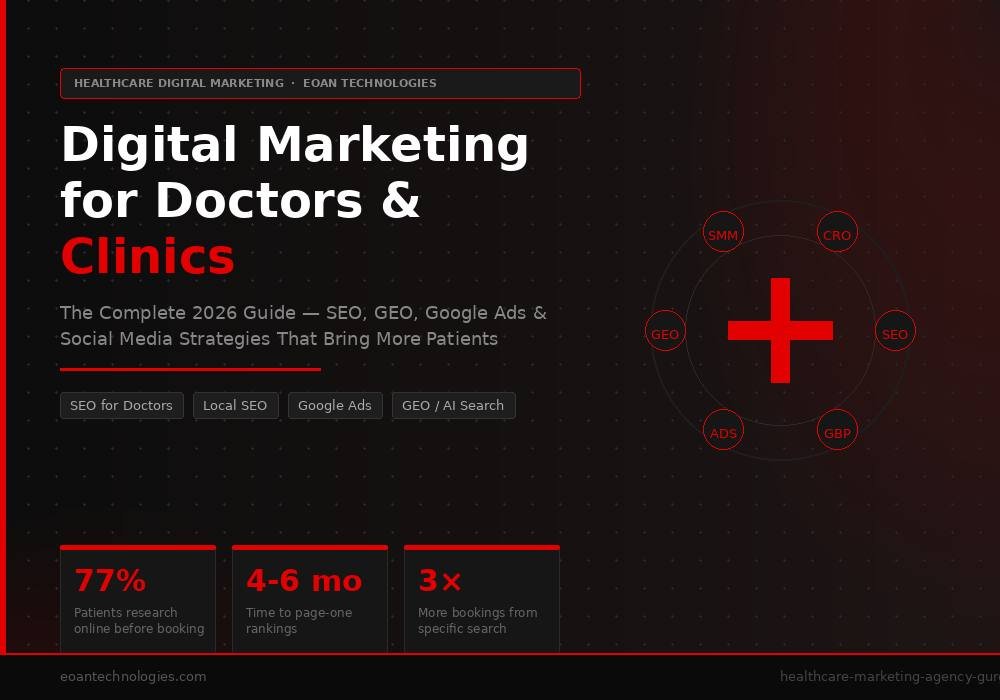
This is the daily reality for thousands of doctors and clinics across India in 2026. Healthcare digital marketing is no longer a growth strategy — it is a patient acquisition fundamental. With over 750 million internet users in India and 77% of patients researching healthcare providers online before booking, the question is not whether your practice needs digital marketing. It is whether your digital marketing is actually working.
This guide covers every core digital marketing strategy for doctors and clinics — with actionable tactics, real case study numbers, and honest guidance on what to prioritise based on your practice size and budget.
In This Guide
- How Patients Find Doctors Online — The 3-Phase Journey
- Local SEO & Google Business Profile — Your Single Biggest Lever
- Your Website — Why Most Clinic Websites Lose Patients
- Content Marketing for Doctors — YMYL Rules You Must Know
- Social Media for Clinics — What Actually Works in India
- Google Ads for Doctors — When to Use Paid, When Not To
- GEO — The AI Search Strategy Most Doctors Are Missing
- 3 Real Case Studies — Clinic, Hospital, Individual Doctor
- 5 Common Digital Marketing Mistakes Doctors Make
- Where to Start — Your 90-Day Priority Plan
1. How Patients Find Doctors Online — The 3-Phase Journey
Understanding how patients search is the foundation of effective digital marketing for doctors. The patient journey online is not a single search — it happens in three distinct phases, each requiring a different type of content and visibility.
Phase 1 — Anonymous Research: A patient notices a symptom. They search for information: "what causes sharp knee pain," "symptoms of thyroid problems," "is laser cataract surgery safe." At this stage they are not searching for a doctor — they are searching for answers. The practices that appear here with clear, medically accurate educational content begin building trust before the patient even knows they need an appointment.
Phase 2 — Provider Discovery: The patient now knows they need a specialist. They search: "best orthopaedic doctor Gurgaon," "physiotherapy clinic near Cyber Hub," "gynaecologist Sector 56 reviews." This is where your Google Business Profile, Practo listing, local SEO, and review volume determine whether you are discovered or invisible. Over 60% of healthcare searches include a local modifier — "near me" or a specific area — making this the highest-stakes phase for most clinics.
Phase 3 — Final Decision: The patient has shortlisted two or three options. They visit each website, read about the doctor's qualifications, look at before/after results, read patient testimonials, and check if online appointment booking is available. This phase is won or lost on your website's credibility signals — doctor credentials, procedure explainers, and genuine patient reviews.
Most clinics only invest in Phase 2 visibility. The practices that win consistently invest in all three phases — building content for Phase 1 researchers, local SEO for Phase 2 discovery, and a credible website for Phase 3 conversion.
2. Local SEO & Google Business Profile — Your Single Biggest Lever
For the vast majority of clinics and individual doctors, local SEO delivers the highest ROI of any digital marketing investment. The Google Map Pack — the three listings that appear at the top of local search results — captures over 40% of all clicks for local healthcare searches. If your clinic is in the Map Pack for "physiotherapy clinic Gurgaon," you are receiving a consistent stream of high-intent patients at zero per-click cost.
The foundation of local SEO for doctors is your Google Business Profile (GBP). A fully optimised GBP includes:
- Complete and accurate NAP — Name, Address, Phone consistent with your website and all directories
- Primary and secondary categories correctly set — "Orthopaedic Surgeon" not just "Doctor"
- Services listed with descriptions for each treatment or procedure you offer
- High-quality photos — clinic exterior, reception, treatment rooms, and doctor headshots
- Weekly GBP posts — health tips, procedure information, appointment availability updates
- Consistent review acquisition — a systematic process of requesting reviews from satisfied patients post-appointment
- Q&A management — seeding and answering the questions patients commonly ask
Beyond GBP, local SEO for clinics requires citation consistency — your clinic's details must match exactly across Practo, Lybrate, JustDial, Sulekha, and other Indian health directories. Inconsistent NAP across directories is one of the most common reasons clinics fail to rank in the Map Pack despite having good reviews. Our SEO for clinics and hospitals service covers GBP management, full citation building, and Practo profile optimisation as an integrated package.
Quick Win
If you do nothing else this week: open your Google Business Profile, go to "Services," and add every procedure and treatment you offer with a 2–3 sentence description. Most clinics have this blank. Filling it in typically improves Map Pack visibility within 3–4 weeks with no other changes.
3. Your Website — Why Most Clinic Websites Lose Patients
Most clinic websites are built to look professional and then left unchanged for years. They fail at the Phase 3 conversion task — turning a research-phase visitor into a booked appointment — for consistently predictable reasons.
The 5 things that lose patients on clinic websites:
1. Slow loading on mobile. Over 70% of healthcare searches in India happen on mobile. A clinic website that takes more than 3 seconds to load on a 4G connection loses approximately 53% of mobile visitors before the page renders. Google's Core Web Vitals directly impact your search rankings — a slow site ranks lower and converts worse simultaneously.
2. Generic doctor bios. "Dr. [Name] has 15 years of experience in orthopaedics" tells a patient nothing that differentiates you. A high-converting doctor profile includes: specific sub-specialities and the conditions you treat most, surgical volume or procedures performed, publications or hospital affiliations, patient testimonials specific to your speciality, and a professional photo that reads as warm rather than corporate.
3. No online appointment booking. A patient researching at 11pm cannot call your clinic. If your website requires a phone call during business hours to book, you are losing every patient who completes their research outside of 9am–6pm. Even a simple contact form with a 24-hour response promise converts significantly better than a phone number alone.
4. Missing procedure pages. Patients searching for "LASIK surgery Gurgaon cost" or "knee replacement recovery time" are high-intent, close-to-booking searchers. A clinic with a detailed LASIK procedure page — covering what to expect, the technology used, recovery, and cost range — captures this traffic. A clinic without one doesn't.
5. No schema markup. Without medical schema (MedicalOrganization, Physician, MedicalSpecialty, FAQPage), Google cannot properly understand your specialities and surface your practice for the right searches. Schema implementation is a technical fix that takes hours but delivers ranking improvements that last indefinitely.
4. Content Marketing for Doctors — The YMYL Rules You Must Know
Content marketing is the highest-leverage long-term strategy for doctors and clinics — but it has a critical compliance dimension that most generic marketing guides ignore.
Google classifies all health and medical content as YMYL — Your Money or Your Life. This means your blog posts, treatment pages, and patient guides are evaluated under Google's strictest quality standards. The specific framework Google uses is called E-E-A-T: Experience, Expertise, Authoritativeness, Trustworthiness.
In practice, this means healthcare content that ranks sustainably must:
- Be authored or reviewed by a named, qualified medical professional — not a generic "content team"
- Include the author's credentials, medical registration number, and speciality
- Cite reliable medical sources — peer-reviewed journals, WHO, ICMR, NMC guidelines
- Not make unsubstantiated health claims or promise specific treatment outcomes
- Include a clear "last reviewed" date — medical information that appears outdated loses E-E-A-T signals rapidly
- Comply with NMC (National Medical Commission) regulations — doctors in India cannot advertise in ways that could be construed as soliciting patients through false claims
The content types that generate the highest patient acquisition ROI for clinics are: symptom and condition guides targeting Phase 1 research searches, procedure explainers with realistic cost ranges and recovery timelines, local comparison guides ("physiotherapy vs surgery for knee pain"), and FAQ pages answering the exact questions patients ask before their first appointment.
5. Social Media for Clinics — What Actually Works in India
Social media for doctors in India is widely misused — clinics posting generic health awareness quotes and promotional content that generates zero patient enquiries. Here is what actually works, by platform:
Instagram and Facebook: Visual, patient-facing content that builds trust through education rather than promotion. Before/after explanations (without identifiable patient images, per NMC guidelines), "myth vs fact" medical content, doctor day-in-life videos, and procedure demystification content. Posting 3–4 times per week consistently outperforms occasional high-production posts.
YouTube: The highest-trust platform for healthcare content. A 5-minute video explaining "what to expect from your first physiotherapy session" or "signs you need to see a cardiologist" builds credibility that no text content can match. YouTube videos embedded on your website also improve Google rankings for those pages.
LinkedIn: Underused by most clinics but highly effective for doctor personal branding — particularly for specialists targeting corporate health contracts, hospital referrals, or other doctors as referral sources. Publishing thought leadership articles on LinkedIn positions a doctor as a category authority in their speciality.
WhatsApp Business: Often overlooked in digital marketing discussions but one of the highest-conversion channels for Indian healthcare practices. A WhatsApp Business profile with a catalogue of services, automated greeting messages, and a booking link converts appointment enquiries at significantly higher rates than email or website contact forms — patients trust WhatsApp as a direct communication channel.
6. Google Ads for Doctors — When to Use Paid, When Not To
Google Ads (PPC) is the right tool for specific scenarios — and the wrong tool when misapplied. For doctors and clinics, the decision framework is straightforward:
Use Google Ads when: You are launching a new practice or new service and need immediate patient volume before organic SEO builds. You offer high-value procedures (IVF, LASIK, joint replacement, cosmetic surgery) where a single converted patient covers months of ad spend. You are in a competitive local market where the Map Pack is dominated by well-established competitors and you need a shortcut to visibility while SEO develops.
Do not rely on Google Ads when: You are using it as a substitute for SEO with no long-term organic strategy. Healthcare Google Ads in India are expensive — cost per click for terms like "IVF clinic Gurgaon" ranges from ₹80–₹250 per click. Without a properly optimised landing page and conversion tracking, this budget disappears without measurable patient acquisition.
The most effective approach for most clinics is parallel channel investment: Google Ads for immediate visibility while SEO builds organic rankings over 4–6 months, then reducing paid spend as organic traffic grows to supplement and eventually outperform paid on cost-per-patient.
7. GEO — The AI Search Strategy Most Doctors Are Missing in 2026
Here is a patient behaviour shift that most healthcare digital marketing guides have not yet addressed: a growing proportion of health-related searches are no longer happening on Google at all.
Patients in India — particularly the urban, educated demographic that makes up the majority of specialist clinic patients — are increasingly asking AI tools their health questions. "Which hospital is best for cardiac surgery in Gurgaon?" "What are the symptoms of PCOS and which specialist should I see?" "Is physiotherapy or surgery better for a torn ACL?" These questions are being asked to ChatGPT, Google AI Overviews, and Perplexity — and those AI tools generate answers by pulling from websites they consider authoritative.
If your clinic's website does not have properly structured, comprehensive content that AI systems can cite, you are invisible to this search channel entirely. This is what we call GEO — Generative Engine Optimisation — and it is the most significant new development in healthcare SEO services in 2025–26.
The four concrete GEO actions every clinic should implement:
- FAQPage schema on every service page — structured Q&A that AI systems can directly cite when answering patient questions
- Bing Webmaster Tools submission — ChatGPT's search index is powered by Bing, and most healthcare websites are not submitted
- Comprehensive treatment pages — AI systems cite content that answers questions thoroughly; thin service pages with 200 words are never cited
- Doctor entity signals — consistent mentions of your doctor's name, credentials, and speciality across your website, Practo, medical directories, and third-party publications signals to AI systems that your doctor is a real, verifiable authority
8. Real Case Studies — What Digital Marketing Delivers for Doctors
Case Study 01 — Physiotherapy Clinic, Sector 56 Gurgaon
From 200 GBP Views/Month to 3,800 — In 16 Weeks
Situation: A 3-doctor physiotherapy clinic in Sector 56 was generating all new patients through JustDial listings and word-of-mouth. Their Google Business Profile had been set up but never properly optimised — wrong primary category, no services listed, 6 photos uploaded 3 years ago, and 11 reviews.
What we did: Correct category set to "Physical Therapist." 14 services added with descriptions. 47 professional photos uploaded across 6 categories. Review acquisition campaign targeting post-appointment WhatsApp messages — from 11 to 68 reviews in 12 weeks. Weekly GBP posts. Citation corrections across JustDial, Practo, Sulekha. Two locality-specific landing pages built for Sector 56 and Sector 50.
Results at 16 weeks: GBP views from 200/month → 3,800/month. Map Pack ranking for "physiotherapy clinic Sector 56 Gurgaon" moved from position 7 to position 2. New patient enquiries from Google: 4/month → 28/month. JustDial subscription cancelled — the ROI comparison made it unjustifiable.
Case Study 02 — Multi-Speciality Clinic, Delhi NCR
22 Page-One Rankings in 5 Months — 0 Before Campaign Start
Situation: An 8-speciality clinic with a well-designed website that ranked for nothing — zero page-one positions, 340 organic visitors/month (almost entirely branded searches for the clinic name), and no blog or content strategy. They were spending ₹45,000/month on JustDial and IndiaMart with inconsistent results.
What we did: Technical SEO audit revealed 23 critical issues — page speed at 38/100 on mobile, missing schema, duplicate meta tags across all department pages, no HTTPS on some subpages. Technical fixes deployed in weeks 1–3. Keyword map across 8 specialities and 4 geographic targets. 8 department-specific service pages rebuilt with E-E-A-T content, doctor attribution, and FAQPage schema. 6 blog posts targeting Phase 1 research searches. Backlinks from 3 healthcare publications.
Results at 5 months: 22 keywords on page one. Organic visitors: 340/month → 2,100/month. Organic appointment enquiries: 6/month → 41/month. JustDial budget reduced by 70% — organic search ROI was 4× higher on cost-per-enquiry basis.
Case Study 03 — Individual Orthopaedic Surgeon, Gurgaon
Doctor Personal Brand SEO — Appearing in ChatGPT Answers
Situation: A senior orthopaedic surgeon with 18 years of experience and a strong referral network wanted to reduce dependence on hospital referrals and build direct patient acquisition. Their online presence was limited to an unclaimed Practo profile and a 5-page website with no blog.
What we did: Built a comprehensive doctor profile page with sub-speciality focus (knee replacement and sports injuries), published credentials, surgical volume, and 12 patient case study summaries (anonymised). Practo profile claimed and fully optimised. 10 articles on knee conditions and sports injuries published — all authored under the doctor's name with medical citations. Physician schema implemented. Bing Webmaster Tools submitted for GEO. FAQ schema added to all 10 articles.
Results at 6 months: Page one for "knee replacement surgeon Gurgaon" and "sports injury specialist Gurgaon." Organic direct patient enquiries: 0/month → 14/month. Doctor's name now cited in ChatGPT responses when users ask about knee replacement specialists in Gurgaon. Referral dependency reduced — 35% of new patients now arrive via direct Google search, up from 0%.
9. 5 Common Digital Marketing Mistakes Doctors Make
1. Treating JustDial/IndiaMart as a digital marketing strategy. Directory listings are not digital marketing — they are paid referral services that cost more per patient acquisition than SEO within 12 months of a properly executed campaign. Most clinics spending ₹30,000–₹50,000/month on JustDial could generate the same patient volume organically at a fraction of the cost after 6 months of SEO.
2. Publishing AI-generated medical content without medical review. In 2026, dozens of healthcare marketing agencies are publishing AI-written health articles at scale for clinic clients. Google's 2024 and 2025 Helpful Content updates actively penalise this — YMYL content without genuine medical expertise signals is being pushed down or deindexed. The short-term content volume gain is a long-term ranking liability.
3. Ignoring Practo while focusing only on Google. In Indian healthcare search, Practo itself ranks on page one for many "doctor near me" and speciality searches. A well-optimised Practo profile captures patients who discover you via Practo directly and also strengthens your Google local SEO through citation consistency.
4. Running Google Ads to a homepage. Sending paid healthcare traffic to a generic clinic homepage instead of a procedure-specific landing page wastes 60–70% of ad spend. A patient clicking on an ad for "knee replacement Gurgaon" and landing on a homepage with no immediate, relevant content bounces within 10 seconds. Every campaign needs a dedicated, conversion-optimised landing page.
5. No review acquisition system. Reviews are the single most influential factor in Phase 3 patient decision-making. Yet most clinics rely on patients volunteering reviews spontaneously — which generates a fraction of the reviews that a systematic post-appointment WhatsApp or SMS request generates. A simple automated review request process, sent 24 hours after an appointment, typically increases Google review volume by 3–4× within 60 days.
10. Your 90-Day Priority Plan — Where to Start
If you are starting from scratch or want to reset your digital marketing strategy, here is a prioritised 90-day action plan based on what consistently delivers the fastest patient acquisition ROI for Indian clinics:
Days 1–30
Foundation
- ✓ Technical SEO audit and critical fixes
- ✓ GBP optimisation — categories, services, photos
- ✓ Practo profile claim and optimise
- ✓ Review acquisition system set up
- ✓ Medical schema implementation
Days 31–60
Content & Local
- ✓ Service pages for each speciality
- ✓ Doctor bio pages with E-E-A-T signals
- ✓ Citation building across directories
- ✓ First 4 blog posts — Phase 1 research topics
- ✓ FAQPage schema on key pages
Days 61–90
Growth & GEO
- ✓ Bing Webmaster Tools — GEO setup
- ✓ Link building from health directories
- ✓ Google Ads campaign (if applicable)
- ✓ Social media content calendar live
- ✓ Monthly reporting baseline set
Every clinic and doctor practice is different — a solo GP clinic in Noida Extension needs a completely different strategy from a 10-speciality hospital in Gurgaon's Cyber Hub corridor. The 90-day plan above is a starting framework; the right strategy for your practice depends on your speciality, your competition, your catchment area, and your current digital baseline.
Free Healthcare SEO Audit
Is Your Clinic Visible to Patients Who Are Searching Right Now?
Our team will audit your current Google rankings, GBP status, keyword gaps vs local competitors, website technical health, and AI search visibility — and send you a clear action plan within 48 hours. No cost, no obligation.
📞 9990361301 · ✉ [email protected] · Response within 48 hours