

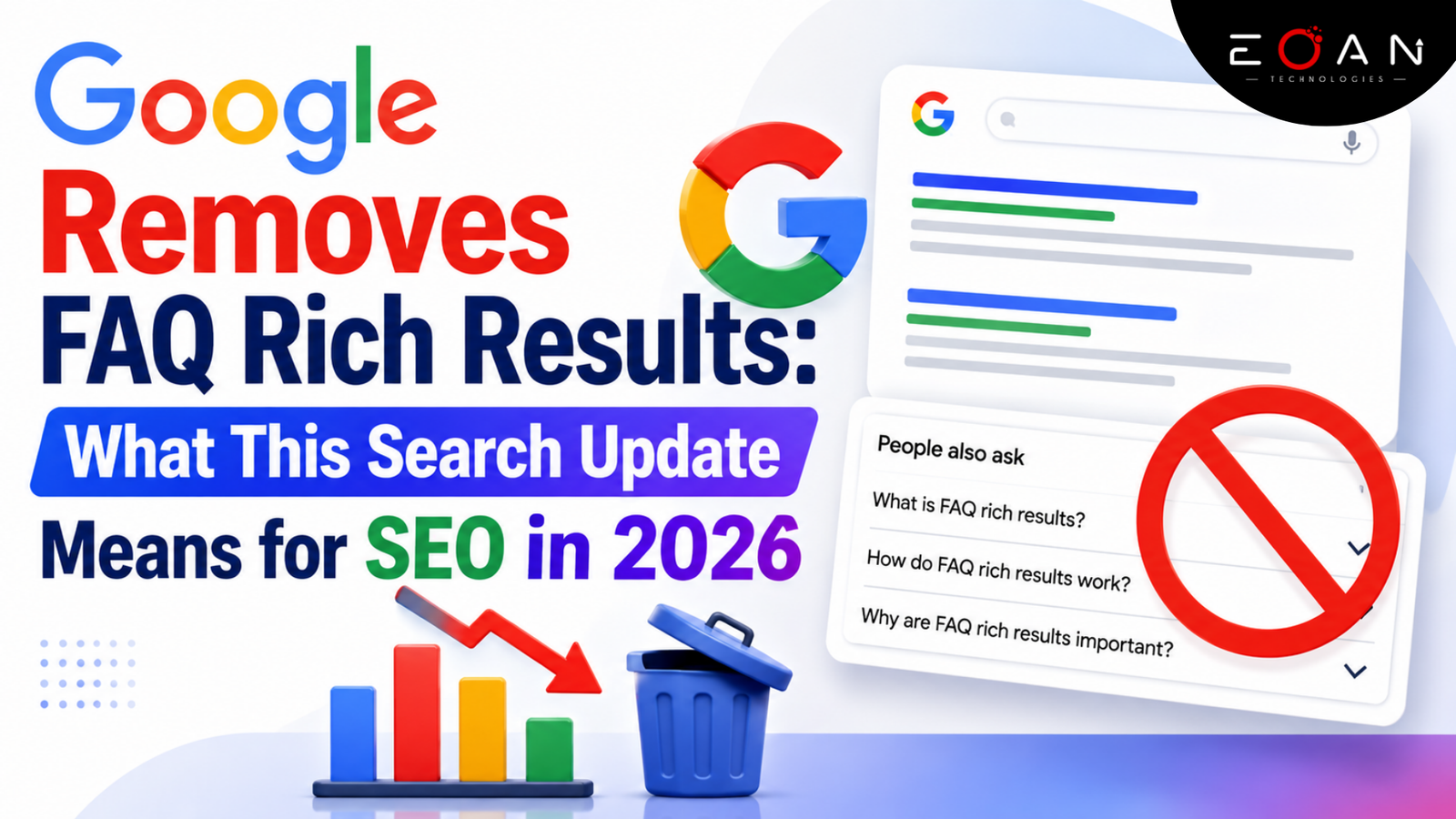
The google faq rich results update has become one of the most discussed topics in the SEO industry. Website owners, SEO professionals, publishers, and digital marketers are all asking the same question: Has Google completely removed FAQ rich results, and what does this mean for rankings in 2026?
If you have relied on the FAQ schema to improve visibility, boost click-through rates, or earn extra SERP real estate, this update matters.
The reality is that Google has significantly reduced FAQ rich results visibility, changing how structured data contributes to search performance. While schema markup remains relevant, the role of FAQ markup has shifted dramatically.
This Google search update 2026 is not simply about one feature disappearing. It reflects a broader transformation in how Google evaluates content quality, search intent, and structured data signals.
In this guide, we break down what happened, why Google made this change, how it affects your SEO strategy, and what actions you should take now.
What Is the Google FAQ Rich Results Update?
The google faq rich results update refers to Google’s continued limitation of FAQ rich snippets in standard search results.
Previously, websites could implement FAQ schema markup and become eligible for expandable FAQ snippets beneath their listings. These snippets helped:
- Increase SERP visibility
- Improve click-through rates
- Push competitors lower on the page
- Occupy more visual space
- Enhance user engagement
For years, FAQ structured data became a common SEO tactic.
Then Google changed direction.
Google removes faq rich results shift began when Google scaled back broad FAQ snippet eligibility, limiting visibility significantly.
Today, many websites still use FAQ schema markup—but those rich results rarely appear.
This means faq rich results removed does not necessarily mean the FAQ schema is invalid. It means Google now chooses to display it far less often.
Why Did Google Remove FAQ Rich Results?
Google’s objective has always been better search quality.
The widespread use of the FAQ schema created several problems.
1. SERP Clutter
Search pages became crowded.
Instead of clean search results, users saw listings overloaded with dropdown questions.
This created:
- Poor search experience
- Repetitive information
- Reduced result diversity
Google prefers cleaner interfaces.
2. Low-Value FAQ Abuse
Many websites began using the FAQ schema purely for rankings.
Common issues included:
- Fake FAQs
- Keyword stuffing
- Repetitive question patterns
- FAQs unrelated to user intent
- Automatically generated schema blocks
This reduced trust in structured data.
3. Better AI Search Understanding
Google’s search systems now better understand page content without relying heavily on explicit FAQ markup.
Advances in:
- Natural language processing
- Semantic indexing
- Entity understanding
- AI-driven intent matching
have reduced dependence on rigid schema structures.
This aligns with broader schema markup changes in 2026 across search ecosystems.
Did Google Completely Remove FAQ Schema?
No.
This is where many SEOs misunderstand the update.
Google FAQ schema still exists.
But visibility has changed.
That means:
| Feature | Status |
| FAQ Schema Markup | Still valid |
| FAQ Rich Snippets | Highly restricted |
| Structured Data Testing | Still supported |
| Search Console Validation | Available |
| Guaranteed SERP Display | No |
The Google rich snippets update is about display eligibility—not schema death.
How This Affects SEO in 2026
The google faq rich results update changes several SEO assumptions.
Lower Click-Through Rates for Some Pages
Sites that depended on FAQ snippets may notice CTR declines.
Why?
Because FAQ snippets once:
- Expanded search footprint
- Created visual differentiation
- Improved trust signals
Without them, listings become smaller.
Reduced “Easy Win” SEO Tactics
The FAQ schema used to be a fast implementation with visible gains.
That shortcut is gone.
Modern SEO now requires a stronger focus on:
- Content quality
- Search intent
- EEAT
- topical authority
- entity relevance
Less SERP Real Estate Manipulation
Some publishers used the FAQ schema aggressively.
Google’s update levels the field.
Now, ranking depends more on actual relevance than on snippet expansion tricks.
Which Industries Are Most Affected?
Some sectors relied heavily on FAQ markup.
These include:
SaaS
Software pages often use FAQ blocks for:
- pricing concerns
- integrations
- onboarding questions
Impact: High
SEO & Marketing Websites
SEO blogs aggressively adopted the FAQ schema.
Impact: Very high
Affiliate Publishers
Review sites used FAQ markup to improve click-through performance.
Impact: High
Local Businesses
Local service providers often add the FAQ schema.
Impact: Moderate
E-commerce Stores
Product and category pages sometimes include FAQs.
Impact: Medium
Google Search Update 2026: Bigger Than FAQ Snippets
This is not an isolated change.
The Google search update 2026 reflects broader priorities.
Google increasingly rewards:
- helpful content
- original expertise
- topical authority
- clean UX
- trustworthy signals
And devalues:
- manipulative schema use
- thin content
- template-heavy pages
- SERP gaming tactics
The FAQ update is part of that trend.
Should You Remove FAQ Schema?
Not always.
This depends on the purpose.
Keep FAQ schema if:
FAQs genuinely help users
questions address real objections
Answers improve page experience
Structured content supports understanding
Consider removing if:
❌ FAQ exists only for SEO manipulation
❌ repetitive across hundreds of pages
❌ low-quality autogenerated questions
❌ keyword stuffing patterns
The right decision depends on content quality.
Better SEO Alternatives After FAQ Rich Results Removed
If faq rich results removed affects your traffic, pivot strategically.
1. Focus on Featured Snippets
Featured snippets remain valuable.
Optimize for:
- concise answers
- clear headings
- direct definitions
- numbered steps
Example:
What is the FAQ schema?
The FAQ schema is structured data that helps search engines understand question-answer content.
2. Strengthen Topical Authority
Google increasingly rewards subject depth.
Instead of adding FAQ blocks everywhere:
Build clusters around:
- SEO updates
- technical SEO
- schema strategy
- search engine changes
Authority wins.
3. Improve CTR Through Better Titles
Without FAQ snippets, titles matter more.
Use:
- emotional triggers
- numbers
- current year relevance
- search intent alignment
Example:
Weak: SEO Update Guide
Better: Google FAQ Rich Results Update: What SEOs Must Know in 2026
4. Invest in EEAT Signals
Trust matters more than markup tricks.
Improve:
- author bios
- expert citations
- brand transparency
- original research
- real experience signals
5. Optimize for AI Search
Search is shifting toward AI-driven experiences.
Prepare with:
- structured content
- entity clarity
- semantic completeness
- conversational formatting
Common SEO Mistakes After Google Removes FAQ Rich Results
Avoid panic reactions.
Mistake 1: Deleting All Schema
Not smart.
Other schema still matters.
Examples:
- Article
- Product
- Breadcrumb
- Organization
- LocalBusiness
- VideoObject
Mistake 2: Stuffing New Schema Types
Some sites replace FAQ abuse with review abuse.
Bad idea.
Google detects manipulation.
Mistake 3: Ignoring User Intent
Rich results never replace relevance.
Intent matching remains critical.
Mistake 4: Publishing Thin “Update” Content
Many blogs repeat the same summary.
Unique analysis ranks better.
SEO Strategy Shift for 2026
The google faq rich results update sends a clear message.
SEO is evolving from markup-driven visibility to authority-driven discoverability.
Winning sites will focus on:
Technical SEO
- crawl efficiency
- indexing health
- Core Web Vitals
- clean architecture
Content Quality
- original insights
- expertise
- clear answers
- intent alignment
Brand Signals
- mentions
- trust
- consistency
- reputation
Semantic SEO
- entities
- topical depth
- contextual relevance
Quick Comparison: Before vs After Update
| SEO Factor | Before FAQ Update | After FAQ Update |
| FAQ Schema Value | High | Limited |
| Rich Snippet Visibility | Common | Rare |
| CTR Boost | Strong | Lower |
| Structured Data Abuse | Common | Penalized/ignored |
| Content Quality Importance | Medium | Very High |
| EEAT Weight | Growing | Critical |
Final Thoughts
The google faq rich results update is not the end of schema markup.
It is the end of lazy structured-data SEO.
If your strategy relied on SERP expansion hacks, adaptation is necessary.
If your strategy focuses on user value, expertise, and search intent, this update creates an opportunity.
Modern SEO in 2026 rewards trust—not shortcuts.
FAQs
1. Did Google completely remove FAQ rich results?
No. Google has heavily restricted FAQ rich snippets, but FAQ schema markup still exists.
2. Should I still use the FAQ schema in 2026?
Yes, if your FAQs genuinely help users and improve page clarity.
3. Why did Google remove FAQ rich results?
To reduce SERP clutter, prevent schema abuse, and improve search quality.
4. Is this part of the Google search update 2026?
Yes, it aligns with broader search quality and structured data changes.
5. What should replace FAQ SEO strategies?
Focus on EEAT, topical authority, featured snippets, technical SEO, and high-quality content.