

How Many Articles Do You Need for SEO?
The honest answer is not a number. It is a framework — and the Australian businesses that understand it are the ones building organic traffic that compounds, not content archives that collect dust.
Every Australian business owner who has ever looked at their competitor’s blog and thought “they publish five posts a week — maybe I should too” has asked the wrong question. The right question is not how many articles you need. It is which articles, structured how, and built around what strategy. Get that right and twenty well-executed posts can outperform two hundred mediocre ones. Get it wrong and you are creating content overhead with no return.
This guide answers the questions that actually matter — including the ones most SEO agencies in Australia do not answer directly because the real answer requires nuance rather than a reassuring number.
SEO Content Strategy — What Actually Determines How Many Articles You Need
Before any number makes sense, you need a content strategy. A content strategy is not a content calendar. It is not a list of blog topics. It is the deliberate architecture of how your content covers a topic comprehensively enough for Google to consider your site an authoritative source — and how that architecture maps to the searches your actual customers make when they are ready to buy.
The foundational concept is topical authority. Google does not rank individual articles in isolation. It evaluates your site’s coverage of a subject area holistically. A site that has ten deeply interconnected articles covering every dimension of a topic will consistently outrank a site that has one article that mentions the same topic in passing — even if that one article has more backlinks.
The Three-Layer Content Framework
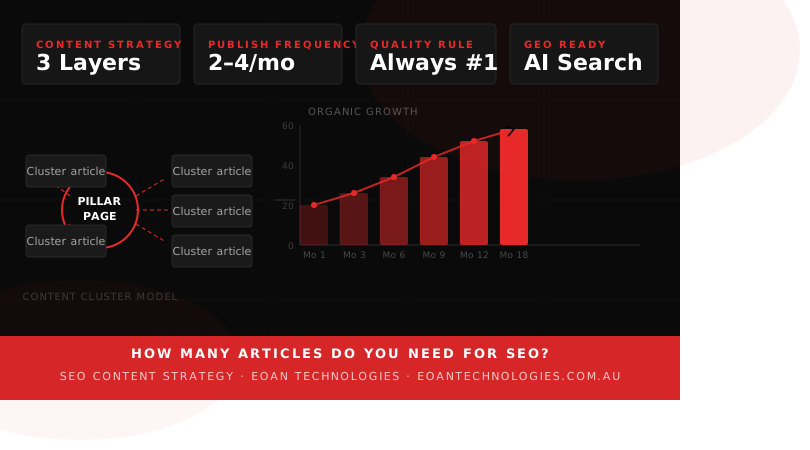
A functioning SEO content strategy has three layers. Most Australian businesses only build one of them.
Pillar Pages (Service or Topic Hubs)
These are your core service or topic pages — comprehensive, long-form, and built to rank for your primary commercial keywords. They are not blog posts. They are the foundation of your content architecture. For a Melbourne accountant, this might be a page targeting “tax accountant Melbourne.” Everything else links back to these.
Cluster Content (Blog Articles)
These are the articles that surround your pillar pages — addressing specific questions, subtopics, and related searches that your target audience makes. Each cluster article targets a narrower keyword, answers one specific question well, and links back to the relevant pillar page. This is where the “how many articles” question actually lives.
GEO-Optimised Content
The third layer — increasingly essential in 2025 and 2026 — is content structured to appear in AI-generated answers. ChatGPT, Google’s AI Overviews, and Perplexity cite sources. Content built with direct-answer formats, FAQ schema, and entity signals gets cited. Content that reads like a traditional blog post rarely does. Eoan integrates GEO into every content strategy from the start.
The number of articles you need is determined by how many cluster topics exist within your pillar subjects — which is driven by keyword research, not by arbitrary publishing targets. A law firm in Sydney might have five pillar pages, each supported by eight to twelve cluster articles, totalling forty to sixty articles across the site. A local plumber in Adelaide might need five to ten cluster articles per service. The number flows from the strategy, not the other way around.
Does Publishing More Content Improve My SEO Rankings?
No — and yes. The nuance matters because getting this wrong is expensive.
More content does not improve rankings on its own. Google’s Helpful Content system — updated significantly in 2024 and 2025 — actively penalises sites that produce high volumes of low-quality, undifferentiated content. Australian businesses that took the “publish more” advice at face value and outsourced 50 generic articles to cheap content farms saw their organic traffic drop, not grow, as Google’s quality signals improved.
What more content does do, when it is the right content:
- It expands your keyword surface area — more articles covering more specific queries means more entry points to your site from search
- It builds topical authority signal — Google sees comprehensive coverage of a subject area as an indicator of genuine expertise
- It creates more internal linking opportunities, which distributes page authority across your site more effectively
- It provides more opportunities to earn backlinks, since specific, useful articles attract links from other sites that reference them
- It creates more GEO citation opportunities — AI platforms have more content to cite when answering questions in your area
The Quality Threshold Question
There is a quality threshold below which publishing more content actively harms your rankings. Google’s Helpful Content classifier evaluates your site holistically — a large proportion of low-quality content on your domain suppresses the rankings of your good content. This is the single most common mistake Eoan sees on Australian business websites: a handful of genuinely useful service pages dragged down by a blog full of 400-word filler articles that were published because someone said “post twice a week.”
The practical implication: audit your existing content before creating new content. If your blog has articles that are thin, outdated, or simply not useful to anyone, consolidating or removing them often improves rankings faster than publishing new articles. This is counterintuitive but consistently supported by how Google’s quality signals work.
Content Frequency for SEO
Publishing frequency is one of the most misunderstood components of SEO strategy. Google does not reward frequency as a ranking signal. There is no algorithm bonus for publishing every Monday. What Google rewards is freshness where freshness matters, and quality consistently.
Freshness matters for certain content types — news, rapidly changing industries, time-sensitive searches. For most Australian businesses in stable service categories (accounting, legal, dental, trades, professional services), freshness is far less important than relevance, depth, and authority. A well-written article about commercial property law that is two years old will outrank a thin article published yesterday on the same topic.
What Does Frequency Actually Affect?
| Frequency Factor | What It Actually Affects | SEO Impact |
|---|---|---|
| Crawl budget | Google crawls active sites more often — frequent publishing can accelerate indexing of new pages | Moderate — useful for large sites |
| Topical coverage speed | Publishing more often completes your content cluster architecture faster | High — if strategy-driven |
| Content quality | Rushing to hit publishing targets degrades quality — which has a direct negative impact | Very high — quality beats frequency |
| Audience trust | Consistent publishing builds brand familiarity and repeat visitors | Moderate — indirect SEO signal |
| E-E-A-T signals | Frequent, expert-authored content builds author and brand entity recognition | High — especially for YMYL topics |
The Right Frequency for Australian Businesses
For most small to medium Australian businesses, the optimal publishing frequency is two to four high-quality articles per month — not because that is a magic number, but because it is typically the rate at which a business can produce genuinely useful, well-researched content without sacrificing quality for volume.
For larger businesses with dedicated content teams, four to eight articles per month is achievable without quality degradation. For solo operators or small businesses managing content alongside everything else, one well-executed article per month that genuinely answers a specific customer question is more valuable than four hastily produced articles that say nothing new.
How Many Blog Articles Do You Need to Rank on Google?
This is the most direct version of the question and it deserves a direct answer: there is no universal number. But there are directional benchmarks that hold across most Australian business categories.
By Business Type — Realistic Starting Points
| Business Type | Typical Pillar Pages | Blog Articles to Establish Authority | Timeline to Visible Results |
|---|---|---|---|
| Local service business Plumber, electrician, cleaner |
3–5 | 10–20 | 3–6 months |
| Professional services Accountant, lawyer, financial advisor |
5–8 | 20–40 | 4–8 months |
| Healthcare practice Dental, physio, GP |
6–10 | 25–50 | 4–8 months |
| E-commerce Product-based online store |
8–15 (category pages) | 30–60+ | 6–12 months |
| B2B services Agency, SaaS, consultancy |
5–10 | 30–60+ | 5–10 months |
| Hospitality / Food & Beverage Restaurant, café, catering |
3–5 | 8–15 | 2–5 months |
These numbers represent the article count needed to establish meaningful topical authority — not the number needed to rank for a single keyword. A single well-optimised service page can rank for a low-competition local keyword without any supporting blog articles. But ranking for competitive terms like “family lawyer Sydney” or “accountant Melbourne” requires both strong pillar content and a supporting cluster that signals depth of expertise.
The Real Variable: Competition Level
The single biggest determinant of how many articles you need is the competitive landscape of your keywords. An Adelaide-based business targeting local customers in a low-competition niche might rank with ten well-executed articles. A Sydney-based business competing for national terms against established sites with years of authority and thousands of backlinks needs a far more substantial content programme — and content alone won’t be sufficient without a concurrent link acquisition strategy.
This is why keyword research is the prerequisite to answering “how many articles do I need.” Without understanding the competitive difficulty of your target keywords, any number is a guess.
How Often Should You Publish Blog Posts?
The honest answer: as often as you can publish well. The unhelpful answer that most marketing content gives you: “two to four times per week” — a benchmark derived from studies of large media organisations with dedicated editorial teams, not from small Australian service businesses managing content alongside actual client delivery.
Frequency by Business Stage
New Website — Foundation Phase (Months 1–6)
Priority is building your core pillar pages and initial cluster content. For most Australian businesses, this means two to four articles per month at minimum, focused on the highest-priority keyword clusters. Speed matters here — Google takes time to recognise and assess new content, so getting your foundational articles published early gives the algorithm more time to evaluate them. Don’t sacrifice quality to hit targets, but do prioritise getting the core architecture live.
Growth Phase (Months 6–18)
Once foundational content is live and beginning to rank, the focus shifts to expanding topical coverage and targeting secondary keyword clusters. Two to four articles per month remains appropriate for most businesses. The content calendar is now driven by keyword gap analysis — what topics are competitors covering that you are not, and what questions are your potential customers asking that your site doesn’t yet answer.
Maintenance Phase (18+ Months)
At this stage, the content library is established and the priority shifts to updating existing content — refreshing statistics, adding new sections, consolidating underperforming articles, and expanding coverage as new topics emerge in your industry. One to two new articles per month combined with regular content audits typically outperforms continued high-volume publishing on a site with mature content architecture.
The Consistency Principle
If there is one frequency-related signal that genuinely matters for SEO, it is consistency over an extended period. A site that publishes two articles per month reliably for 24 months signals consistent investment in content quality to both Google and to human readers. A site that publishes ten articles in January and nothing for five months afterward signals instability. Google’s crawl patterns reflect this — consistently updated sites are crawled more frequently, meaning new content is indexed faster.
Pick a publishing frequency you can sustain indefinitely at the quality level your strategy requires. That is your correct publishing frequency — regardless of what any benchmark suggests.
Not Sure Where to Start?
Eoan Technologies builds SEO content strategies for Australian businesses — keyword research, content architecture, GEO integration, and ongoing execution. Start with a free audit that shows you exactly what your site needs.
Get Your Free SEO AuditSummary — The Actual Answers
| The Question | The Honest Answer |
|---|---|
| How many articles do I need for SEO? | Determined by your keyword strategy — typically 10–20 for a local business, 30–60+ for competitive B2B or professional services categories |
| Does more content improve rankings? | Yes, if quality is maintained. No, if volume comes at the expense of quality — Google’s Helpful Content system actively demotes sites with high proportions of thin content |
| How often should I publish? | As often as you can maintain quality — typically 2–4 times per month for most Australian businesses |
| How many articles to rank on Google? | A single well-optimised page can rank for low-competition terms. Competitive terms require a full content cluster (6–12+ supporting articles per pillar topic) plus backlinks |
| What matters more — frequency or quality? | Quality. Always. Without exception. |
The businesses ranking consistently in Australian search results are not the ones who published the most. They are the ones who built the best content architecture around the right keywords and maintained it over time. That is a strategy. A publishing schedule is not.
If you want to understand what that strategy looks like for your specific business, industry, and competitive landscape in Australia — start with a free audit from Eoan Technologies. We will show you the keyword gaps, the content architecture your site needs, and a realistic timeline for organic growth — not a number pulled from a benchmark.